
 It’s good to have a friend like my buddy Stan.
Admittedly, he can be a pain—because if he’s not borrowing something he has no intention of returning, he’s asking me to hold onto something that isn’t his.
The guy is always in crisis, and it’s always one of his own making. If he’s not in trouble with the law, he’s in worse trouble with one of his many tumultuous relationships.
Despite all these flaws, he has at least one redeeming quality.
I mean, who else do you know who has a roll-off dumpster permanently parked in their driveway?
So, I gave him a call.
“Stan?”
“Yeah.”
“Thursday is garbage day, and we leave for Arizona on Wednesday. Do you mind if I toss a few bags into your dumpster?”
“No problem.”
See?
When I got to his place, I found Stan under his old truck, fixing something or other—because something or other is always wrong with his truck.
Let me describe it for you.
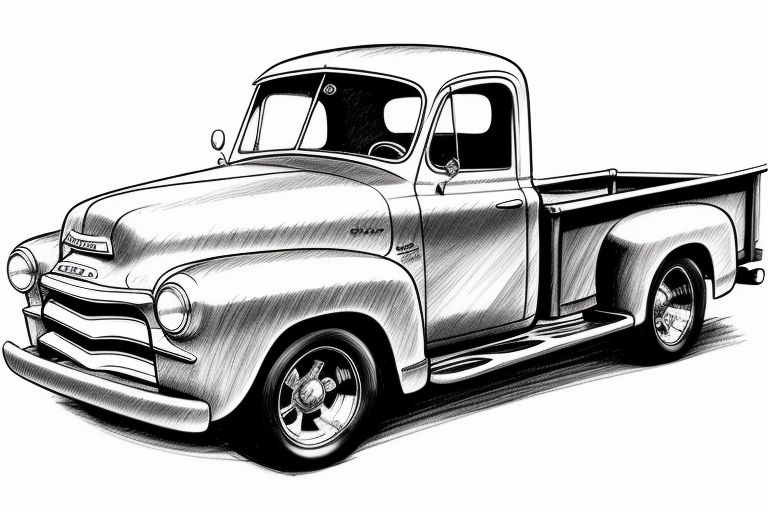
Stan drives a 1951 International Harvester pickup. Originally, it was painted burnt orange, but there’s no longer any trace of that hue because every panel has been replaced with one of a different color, and the replacement is typically in worse condition than the original.
What isn’t rusted through has been patched with sun-bleached resin or flapping sheet metal. There are no bumpers, yet plenty of bumper stickers are plastered all over the tailgate. Most read, “This Country Was Built By God, Guns, and Guts” or some similar sentiment.
In short, it’s the perfect commuting vehicle.
Why do I say that?
Think about it.
Would you want that in your blind spot?
Would you want to be following its cloud of acrid smoke?
Would you want its squealing, grinding, spark-tossing brakes in your rearview mirror?
During rush hour, the lanes part like the Red Sea as Stan’s truck chugs jauntily along.
Still, I tease him about it.
“Stan,” I tell him, “you have a dumpster. Why not just back that thing into it?”
He rolls out from underneath and groans to his feet.
Giving the side panel a kick, he says, “I hate this piece of ****.”
“Then why not get rid of it?”
“Because, as much as I hate it, it loves me, and you can’t betray something like that.”
Stan knows these things. He’s a mechanical genius, a machine whisperer, and though he can’t actually talk to machines, they talk to him.
Still, I ask, “How do you know?”
He spends a moment in quiet contemplation before wiping his greasy hands on his jeans.
“I’ve thought about that,” he says. “This truck is almost as old as I am, and every time I hope it’s about to die, I feel a little queasy, and we both find a way to continue. It always lets me know precisely what’s wrong and has an uncanny knack for knowing just what I’m willing to pay to fix it.”
“Sounds like it has your number.”
“Yeah, it won’t leave me, and if that isn’t love, I don’t know what is.”
And that was that.
I tossed my garbage into his dumpster, and over a few beers, we caught up on some old neighborhood gossip.
When I got home, something in the bed of my truck caught my eye. It was the bags of garbage I’d tossed into Stan’s dumpster.
I called him.
“What gives?”
“You insulted my truck,” he said.
“You did too. You told me you hated it.”
“I did, but it refuses to part with me… kind of like your garbage.”
 Almost Iowa
Just goes to show, never insult a man’s wife…..or his truck! Hope you found a new dumpster for your garbage!
That’ll teach you. I guess my only question is did Stan or his truck return your garbage? My money is on the truck. Fun as always.
Ah, so fun to read about Stan, again. Sounds like my husband and his truck – unable to part even though it’s time.
S
Ah, you’re definitely back when there is a ‘Stan’ post. Thanks for the smile.
Stan is a gold mine of material and he knows it.
So now you’re the garbage whisperer?
I don’t actually whisper to garbage, but after a few days the kitchen trash shouts to be put out. 🙂
I still don’t know why your garbage followed you home. You didn’t insult it.
Stan thinks my garbage holds me in too high of a regard to be separated from me.
Ah. Makes sense.
This was a fun read. You have to be careful not to insult equipment. There’s a strange overlap of human and machine karma. Sounds like Stan understands that.
I swear at my computer…. that probably explains a lot.
Lately, I have been using a Raspberry PI 5. It is very small and remarkably powerful, but most of all, it is very forgiving.
Always a good thing.
LOL
🙂
haha. I love this. That’ll learn ya’!
Yeah, well, wait until I get revenge. 🙂
Clever twist, and as Rivergirl said, “Lesson learned.” Great write!
“Lesson learned.”
Stan and I have known each other for more than a half century and in that time, neither he nor I have learned a blessed thing.
I wish Stan was closer; I’d take my car to him. It’s running fine, but it’s afflicted with a strange vibration/noise that the dealership can’t seem to hear, let alone fix. I don’t need one more kid who can plug a 2011 Toyota into a computer. I need a machine whisperer willing to listen.
And therein defines the difference between analogue and digital. I believe that last week you wrote about sensing the subtle wear on a sander. It is as if the tool was talking to you.
The digital computer can only sense things that it is engineered (taught) to sense. A person senses everything the machine is saying.
The best engineering is when the two are combined.
There is a beautiful line in Thomas Pynchon’s Gravity’s Rainbow during a discussion of how to engineer the trajectory of a rocket. I cannot remember exactly, so I will paraphrase: “Let the machine tell you how to do it.”
Lesson learned? Don’t insult the truck…
🤣
I try not to, but then there are times when one cannot help themselves. 🙂